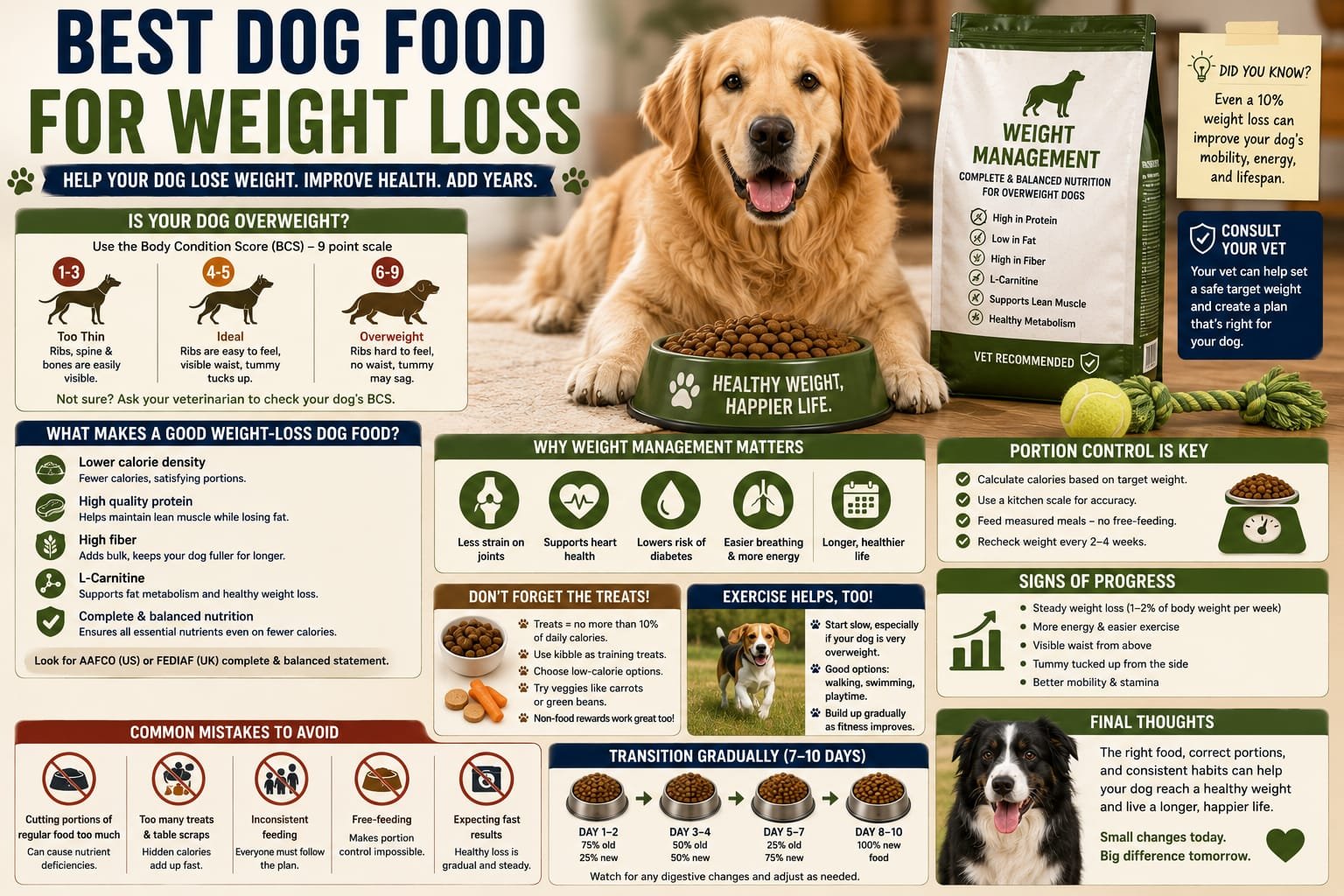
Best Dog Food for Weight Loss in Overweight Dogs
If your vet has told you your dog needs to lose weight, you’re far from alone obesity is one of the most common preventable health problems in dogs across both the US and UK, with a significant proportion of the pet dog population classified as overweight or obese. The good news is that with the right diet plan and a bit of consistency, most dogs can achieve a healthy weight, dramatically improving their comfort, mobility, and long-term health. Here’s how to do it properly.
Why Weight Management Matters So Much
Excess weight isn’t just a cosmetic issue it’s a serious health risk. Overweight dogs face significantly higher risks of osteoarthritis, diabetes, heart disease, reduced life expectancy, and complications with anesthesia if surgery is ever needed. Extra weight puts constant strain on joints, worsens breathing in brachycephalic breeds, and can shorten your dog’s life by a meaningful margin. The encouraging flip side is that even modest weight loss can produce noticeable improvements in mobility, energy, and overall wellbeing.
How to Know If Your Dog Is Overweight
Rather than relying purely on a number on the scale, vets use a Body Condition Score (BCS), typically on a 9-point scale, that assesses your dog visually and by touch:
You should be able to feel (though not necessarily see) your dog’s ribs without excess fat covering
Your dog should have a visible waist when viewed from above
Their abdomen should tuck up when viewed from the side, rather than hanging level with or below the ribcage
If you’re unsure, your vet can assess your dog’s body condition score accurately and help set a realistic target weight.
The Foundation of Weight Loss: Calorie Control
Weight loss in dogs, just as in humans, ultimately comes down to calories in versus calories out. However, simply feeding less of your dog’s regular food isn’t the best approach, since it can lead to nutrient deficiencies if you’re not also adjusting the nutritional density of what they’re eating. This is where a dedicated weight management formula becomes valuable.
What Makes a Good Weight-Loss Dog Food
Lower calorie density, higher nutrient density: Weight management formulas are designed so your dog can eat a satisfying volume of food while still consuming fewer calories overall, and still receive complete nutrition despite the calorie reduction.
Higher protein content: Adequate protein helps preserve lean muscle mass during weight loss, ensuring the weight lost is primarily fat rather than muscle.
Higher fiber content: Fiber adds bulk and volume without adding many calories, helping your dog feel fuller and more satisfied after meals reducing begging behavior and food-seeking that can derail a weight loss plan.
L-carnitine: Some weight management formulas include L-carnitine, an amino acid derivative that supports fat metabolism and helps the body use fat stores for energy more efficiently.
Balanced vitamins and minerals: Even with reduced calories, your dog still needs their full complement of essential nutrients, which is why a purpose-formulated weight loss diet is preferable to simply restricting portions of a regular maintenance food.
Prescription vs Over-the-Counter Weight Management Foods
For dogs who are significantly overweight or have struggled to lose weight with standard approaches, vets may recommend a prescription weight loss diet, which tends to be more calorie-restricted and nutritionally concentrated than over-the-counter “light” or “weight management” formulas. These prescription diets are formulated to allow for a genuinely satisfying food volume while achieving more significant calorie deficits, and are typically used under veterinary supervision with regular weigh-ins.
Over-the-counter weight management formulas can work well for dogs who are only mildly overweight or as an ongoing maintenance diet once a target weight has been reached.
How to Calculate Portions Correctly
This is where many weight loss plans go wrong. Simply eyeballing portions or following generic feeding guidelines on the bag often leads to overfeeding, since those guidelines are based on average dogs, not your individual dog’s current weight, target weight, and activity level. Your vet can calculate your dog’s Resting Energy Requirement (RER) and adjust it based on a target weight loss rate typically around 1–2% of body weight per week giving you an accurate daily calorie target rather than a rough guess.
Using a kitchen scale to weigh food, rather than measuring cups, dramatically improves portion accuracy, since cup measurements can vary significantly depending on how the food settles and is scooped.
The Treat Problem
Treats are one of the most overlooked sources of excess calories in a dog’s diet, and they can single-handedly derail an otherwise well-planned weight loss diet. As a general rule, treats should make up no more than 10% of total daily calories and during active weight loss, even less. Consider:
Using small pieces of your dog’s regular kibble as training rewards, counted as part of their daily calorie allowance
Choosing low-calorie treats specifically formulated for weight management
Substituting some treats with non-food rewards, like praise, play, or a favorite toy
Using small pieces of plain vegetables like carrots or green beans as a low-calorie treat alternative
Exercise: The Other Half of the Equation
While diet does the heavy lifting in weight loss, appropriate exercise supports muscle maintenance and speeds progress though it should be introduced gradually, particularly for significantly overweight dogs who may have joint discomfort. Low-impact activities like swimming or gentle walks are often good starting points, with intensity and duration increased gradually as fitness improves and weight decreases.
Monitoring Progress
Regular weigh-ins ideally every 2–4 weeks help track progress and allow for portion adjustments if weight loss stalls or happens too quickly. It’s worth noting that weight loss isn’t always perfectly linear, so don’t be discouraged by a week or two of plateau; consistency over the full timeline matters more than short-term fluctuations.
Common Mistakes in Dog Weight Loss Plans
Cutting portions of regular food too aggressively: This can lead to nutrient deficiencies over time, since standard maintenance food isn’t formulated to provide complete nutrition at drastically reduced volumes.
Inconsistent feeding among household members: If multiple people feed the dog without coordinating, it’s easy to unintentionally double-feed or lose track of treats given throughout the day.
Free-feeding during a weight loss plan: Measured, scheduled meals are essential for accurate calorie tracking; free-feeding makes portion control nearly impossible.
Expecting rapid results: Healthy, sustainable weight loss in dogs is gradual. Rapid weight loss can be a sign of an inappropriately restrictive diet and may pose its own health risks.
Final Thoughts
Helping an overweight dog reach a healthier weight is one of the most impactful things you can do for their long-term health and quality of life. It requires more than just “feeding less” it means choosing a nutritionally appropriate weight management formula, calculating accurate portions, controlling treats, and pairing dietary changes with appropriate exercise. With patience and consistency, and ideally with your vet involved in setting targets and monitoring progress, most overweight dogs can reach and maintain a healthy weight, unlocking noticeably more energy, comfort, and years of healthy life.