Best Large Breed Dog Food: A Complete Feeding Guide
Best Large Breed Dog Food: A Complete Feeding Guide
Large breed dogs think Labradors, German Shepherds, Rottweilers, and Great Danes bring big personalities and big love, but they also come with distinct nutritional needs that smaller dogs simply don’t have. From puppyhood through their senior years, feeding a large breed dog correctly plays a major role in preventing joint problems, maintaining healthy weight, and supporting a long, active life. Here’s what every large breed owner should know.
Why Large Breeds Need Different Nutrition
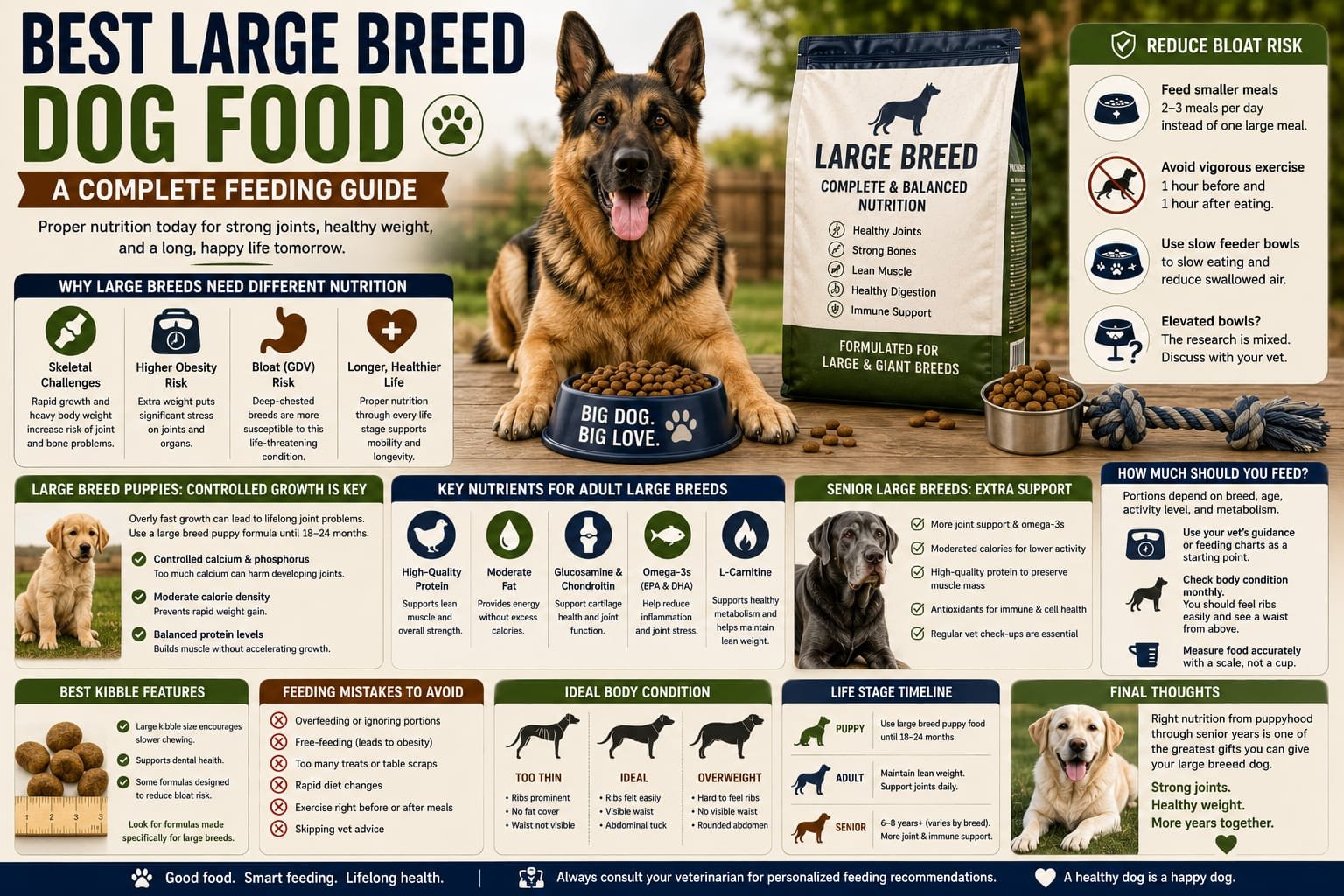
Large and giant breed dogs face a unique set of physical challenges tied directly to their size. Their skeletal frames grow rapidly during puppyhood, they’re more prone to developmental orthopedic conditions like hip and elbow dysplasia, and as adults, they carry significantly more body weight on their joints, making obesity a much bigger risk factor for mobility problems. Additionally, several giant breeds face an elevated risk of gastric dilatation-volvulus (GDV), commonly known as bloat a life-threatening emergency that some feeding practices can help reduce the risk of.
Large Breed Puppies: Controlled Growth Is Everything
This is arguably the single most important nutritional consideration for large breed dogs, and one that’s frequently misunderstood. It might seem logical to feed a large breed puppy more food to help them “grow big and strong” but this approach can actually cause serious harm.
Large breed puppies need to grow at a controlled, steady rate rather than rapidly, because overly fast growth puts excessive strain on developing bones and joints, significantly increasing the risk of hip dysplasia, elbow dysplasia, and other orthopedic conditions later in life. This is why large breed puppy formulas are specifically designed with:
Controlled calcium and phosphorus levels excess calcium during rapid growth phases is strongly linked to skeletal problems
Moderated calorie density — to prevent overly fast weight gain relative to skeletal development
Balanced protein levels — adequate for healthy muscle development, without excessive calories that accelerate growth
Large breed puppies should remain on a large breed-specific puppy formula until they reach skeletal maturity, which can take 18–24 months depending on the breed, considerably longer than the 12-month timeline typical for smaller breeds.
Joint Support Throughout Life
Given their higher risk of joint issues, large breed dogs benefit from diets that support joint health at every life stage, not just as seniors. Key ingredients to look for include:
Glucosamine and chondroitin support cartilage health and joint function
Omega-3 fatty acids (EPA/DHA) have anti-inflammatory properties that can ease joint stress
Appropriate calorie control maintaining a lean body condition throughout life significantly reduces cumulative stress on joints
Many large breed formulas, across all life stages, now include joint-supporting ingredients as standard, reflecting how central this concern is for the breed category as a whole.
Weight Management Is Critical
Because large breed dogs carry substantially more body weight, even modest excess weight translates into significant additional strain on their joints. Studies have shown that maintaining large breed dogs at a lean body condition throughout their lives can meaningfully extend both their healthspan and lifespan. This makes portion control and regular body condition assessment especially important arguably more so than for smaller breeds, where excess weight, while still harmful, places proportionally less mechanical stress on the body.
Reducing Bloat Risk Through Feeding Practices
Gastric dilatation-volvulus (bloat) is a life-threatening condition where the stomach fills with gas and potentially twists, cutting off blood supply and large, deep-chested breeds like Great Danes, Weimaraners, and German Shepherds face a notably higher risk. While the exact causes aren’t fully understood, several feeding practices are commonly recommended to help reduce risk:
Feeding multiple smaller meals rather than one large meal per day
Avoiding vigorous exercise for at least an hour before and after eating
Using slow feeder bowls to reduce rapid eating and excessive air swallowing
Elevated feeding bowls remain debated some earlier research suggested they might increase bloat risk in certain breeds, so it’s worth discussing with your vet rather than assuming elevated bowls are automatically beneficial
Key Nutrients for Adult Large Breed Dogs
Protein (moderate to high quality): Supports lean muscle maintenance, which is important for supporting joints and overall mobility.
Moderate fat content: Provides energy without contributing to excess weight gain, which is a particular concern for larger, often less naturally active adult dogs.
L-carnitine: Supports healthy metabolism and can aid in maintaining a lean body composition.
Joint-supporting nutrients: As mentioned, glucosamine, chondroitin, and omega-3s remain valuable throughout adulthood, not just in senior formulas.
Senior Large Breed Dogs: Additional Considerations
Large breeds are considered senior earlier than smaller dogs often by 6–8 years of age and their nutritional needs shift accordingly. Senior large breed formulas typically emphasize:
Higher levels of joint-supporting nutrients, given the cumulative wear on joints over a lifetime
Moderated calories to match decreased activity levels
Maintained or increased protein quality to help prevent age-related muscle loss
Additional antioxidant support for aging immune systems
Because large breeds are also more prone to certain cancers and health conditions as they age, regular veterinary check-ups become even more important in guiding dietary adjustments during the senior years.
How Much Should You Feed a Large Breed Dog?
Feeding amounts vary considerably based on your dog’s specific breed, age, activity level, and individual metabolism generic feeding charts on packaging are a starting point, not a precise prescription. Regular body condition assessments, ideally monthly, help you fine-tune portions over time. As a general principle, you should be able to feel your dog’s ribs without a thick layer of fat covering them, and see a visible waist when looking at them from above.
Choosing the Right Large Breed Formula
When evaluating large breed dog food, look for:
Life stage-appropriate formulation puppy, adult, or senior formulas specifically designed for large breeds
AAFCO (US) or FEDIAF (UK) statements confirming the food meets complete and balanced nutritional standards for large breeds specifically
Named protein sources as the primary ingredients
Joint-supporting nutrients included as standard, particularly for adult and senior formulas
Appropriate kibble size many large breed formulas use larger kibble pieces designed to encourage slower eating, which can also help reduce bloat risk
Final Thoughts
Large breed dogs bring incredible loyalty and personality, but their size comes with real nutritional responsibilities particularly during the critical growth phase of puppyhood, when growth rate control can meaningfully impact their lifelong joint health. Throughout their lives, prioritizing lean body condition, joint support, and feeding practices that reduce bloat risk will help your large breed companion stay mobile, comfortable, and healthy for as many years as possible. When in doubt about portions or specific nutritional needs, your vet remains your best resource for tailoring feeding to your individual dog.