How Much Should You Feed Your Dog? A Complete Feeding Chart Guide
One of the most common questions dog owners ask and one of the easiest to get wrong is simply: how much should I actually be feeding my dog? Feeding guidelines on packaging often feel like rough guesses, and every dog seems to have slightly different needs. This guide breaks down exactly how to calculate appropriate portions for your dog, why generic charts only get you partway there, and how to adjust over time based on real results.
Why “Just Follow the Bag” Isn’t Always Enough
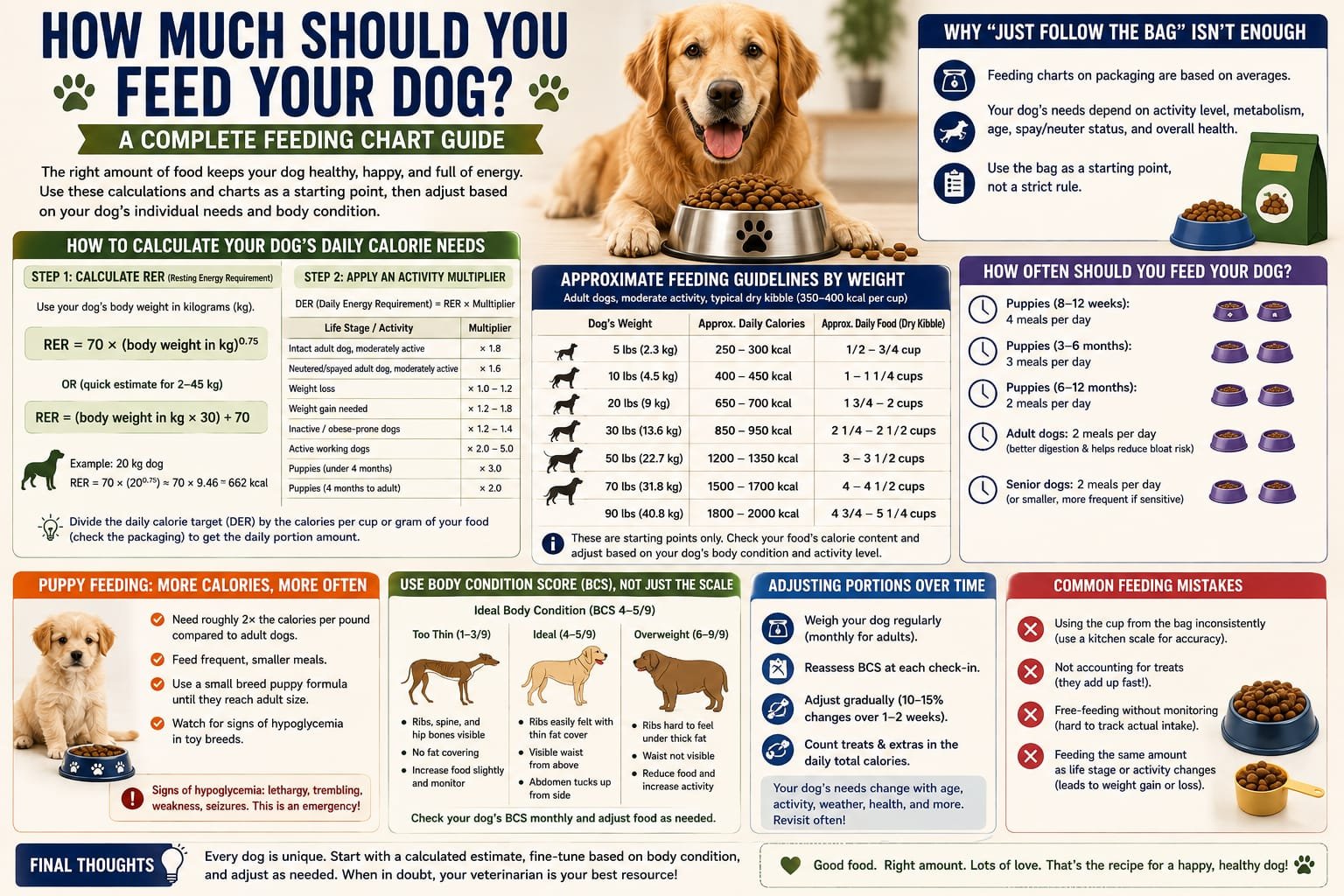
Feeding charts printed on dog food packaging are a reasonable starting point, but they’re based on averages average activity level, average metabolism, average body composition for a given weight range. Your individual dog might be more or less active, have a faster or slower metabolism, or be spayed/neutered (which typically lowers calorie needs by around 20-30%), all of which affect how much they actually need. Treating the bag’s chart as a strict prescription rather than a starting point is one of the most common reasons dogs end up overweight or underweight.
Understanding Caloric Needs: The Basics
A dog’s daily calorie needs are generally calculated in two steps:
Step 1: Calculate Resting Energy Requirement (RER)
RER represents the calories your dog would burn at complete rest, and is calculated using body weight in kilograms:
RER = 70 × (body weight in kg) ^0.75
For a quick estimate for dogs between 2-45 kg, you can also use: RER = (body weight in kg × 30) + 70
Step 2: Apply an Activity Multiplier
Once you have RER, multiply it by a factor reflecting your dog’s life stage, activity level, and reproductive status to get their Daily Energy Requirement (DER):
- Intact adult dog, moderately active: RER × 1.8
- Neutered/spayed adult dog, moderately active: RER × 1.6
- Weight loss: RER × 1.0–1.2
- Weight gain needed: RER × 1.2–1.8
- Inactive/obese-prone dogs: RER × 1.2–1.4
- Active working dogs: RER × 2.0–5.0, depending on intensity
- Puppies (under 4 months): RER × 3.0
- Puppies (4 months to adult): RER × 2.0
This gives you a starting daily calorie target, which you then divide by the calorie content per cup or gram of your specific food (found on the packaging or manufacturer’s website) to determine actual portion size.
Approximate Feeding Guidelines by Weight
While individual needs vary, here’s a general starting reference for adult dogs at a moderate activity level, based on typical commercial dry food caloric density (roughly 350-400 kcal per cup):
| Dog’s Weight | Approximate Daily Calories | Approximate Daily Food (dry kibble) |
|---|---|---|
| 5 lbs (2.3 kg) | 250-300 kcal | 1/2 – 3/4 cup |
| 10 lbs (4.5 kg) | 400-450 kcal | 1 – 1 1/4 cups |
| 20 lbs (9 kg) | 650-700 kcal | 1 3/4 – 2 cups |
| 30 lbs (13.6 kg) | 850-950 kcal | 2 1/4 – 2 1/2 cups |
| 50 lbs (22.7 kg) | 1200-1350 kcal | 3 – 3 1/2 cups |
| 70 lbs (31.8 kg) | 1500-1700 kcal | 4 – 4 1/2 cups |
| 90 lbs (40.8 kg) | 1800-2000 kcal | 4 3/4 – 5 1/4 cups |
These figures are approximate starting points only — always check the specific calorie content of your chosen food, since density varies significantly between brands and formulas, and adjust based on your dog’s actual body condition over time.
Puppy Feeding: A Different Calculation
Puppies need considerably more calories per pound of body weight than adults, given their rapid growth and development. As a rough guide, puppies often need roughly double the calories per pound compared to adult dogs at the same weight, though this ratio decreases gradually as they approach adult size. Because of this intensity, puppy feeding amounts should be based on their expected adult weight and current growth stage, ideally guided by the specific feeding chart provided by your puppy food’s manufacturer, adjusted with input from your vet.
How Often Should You Feed Your Dog?
- Puppies (8-12 weeks): 4 meals per day
- Puppies (3-6 months): 3 meals per day
- Puppies (6-12 months): 2 meals per day
- Adult dogs: 2 meals per day is generally recommended over a single large meal, which supports better digestion and can help reduce the risk of bloat in larger breeds
- Senior dogs: 2 meals per day, sometimes split into smaller, more frequent meals if digestive sensitivity is a factor
Using Body Condition Score, Not Just the Scale
While tracking your dog’s weight is useful, Body Condition Score (BCS) gives a more complete picture of whether your feeding amount is appropriate. On a standard 9-point scale, an ideal body condition means:
- Ribs can be felt easily with a thin layer of fat covering, without being visibly prominent
- A visible waist when viewed from above
- The abdomen tucks up when viewed from the side
If your dog’s ribs are difficult to feel under a thick layer of fat, or their waist isn’t visible, it’s likely time to reduce portions. If ribs, spine, or hip bones are easily visible with no fat covering, it may be time to increase portions or consult your vet.
Adjusting Portions Over Time
Feeding amounts shouldn’t be set once and forgotten they need to be reassessed periodically as your dog’s age, activity level, and health status change:
- Weigh your dog regularly monthly for adult dogs, more frequently for puppies and dogs on a weight management plan
- Reassess body condition score at each weigh-in
- Adjust gradually small portion changes (10-15%) over a couple of weeks, rather than dramatic shifts, help you fine-tune without overshooting
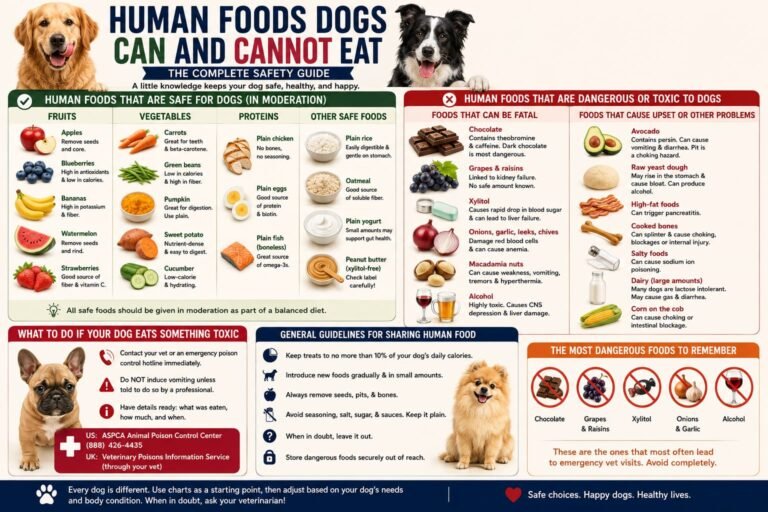
- Account for treats and extras these need to be factored into total daily calories, not treated as separate from the “real” feeding amount
Common Feeding Mistakes
Using the cup that came with the food bag inconsistently: Scoop sizes vary, and how tightly food is packed into a cup measure can create meaningful calorie discrepancies. A kitchen scale offers far more consistent portion accuracy.
Not accounting for treats: Treats, training rewards, and table scraps all count toward daily calorie intake and are a common source of unintentional overfeeding.
Free-feeding without monitoring: Leaving food out constantly makes it difficult to track actual intake and can contribute to overeating in food-motivated dogs.
Feeding the same amount regardless of life changes: A dog who has been spayed/neutered, become less active, or aged into their senior years typically needs fewer calories than they did previously — sticking to old portions without adjustment is a common cause of gradual weight gain.
Final Thoughts
There’s no single universal number that tells you exactly how much to feed your dog it depends on their weight, life stage, activity level, and individual metabolism. Starting with a calculated estimate based on RER and an appropriate activity multiplier, then fine-tuning based on regular body condition assessments, gives you a far more accurate approach than guessing from a generic bag chart. When in doubt, your vet can help you establish an appropriate starting point and guide adjustments over time as your dog’s needs change.